
How the Human Heart and Circulatory System Work
The heart is one of the most important organs in the human body. It is often called the house of emotions, and many songs and poems are written about it. People talk about love using the word “heart,” but in real life, the heart is a powerful muscle that works nonstop to keep us alive. While we can only feel its heartbeat, heart specialists are the ones who can actually touch it during surgeries like bypass operations.
An average human heart beats about 1 lakh times in a single day. In one year, it beats around 35 million times, and in a full lifetime, it beats nearly 2.5 billion times. This raises a simple but important question: what exactly is the heart doing every time it beats? To understand this, we need to learn about the heart and the circulatory system in simple terms.
The Role of the Heart in the Body
The heart is the main part of the circulatory system. The circulatory system is responsible for moving blood throughout the body. This blood flow helps deliver oxygen and nutrients to every part of the body and also removes waste products. Without this system, our cells would not survive even for a few minutes.
Every time the heart beats, it pumps blood to the entire body. This blood carries fresh oxygen from the lungs and nutrients from food to different organs and tissues. Because of this constant circulation, the heart is often called the lifeline of the human body.
Structure of the Heart
If we look at the heart from an anatomical point of view, we find that it is made of several layers of muscles. The outer covering of the heart is called the pericardium, while the inner lining is known as the endocardium.
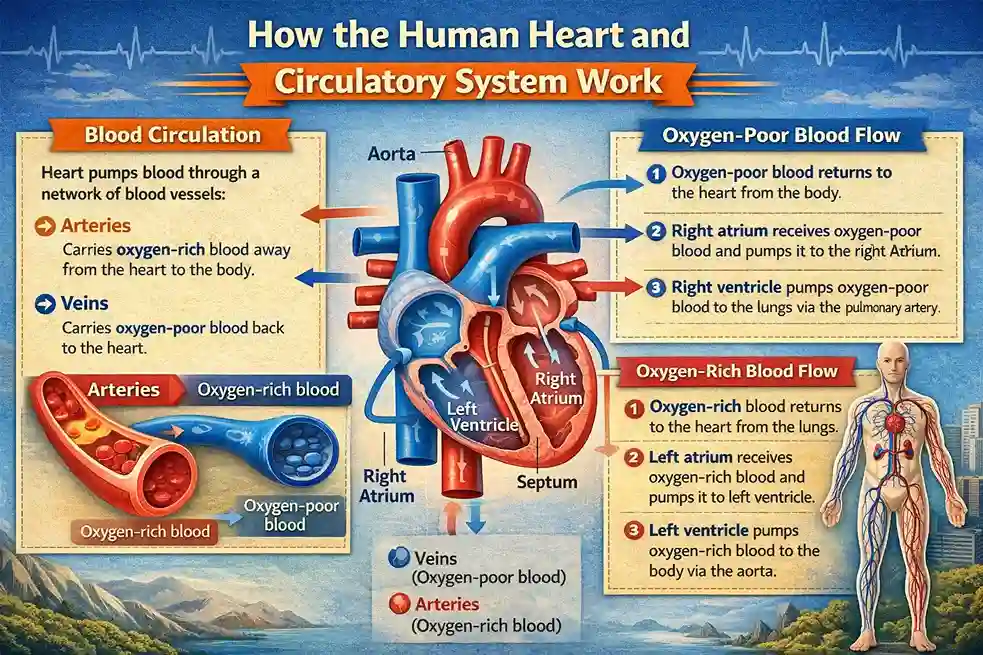
The heart has four chambers. There are two upper chambers and two lower chambers. The upper chambers are called atria, and they receive blood coming into the heart. The lower chambers are called ventricles, and their job is to pump blood out of the heart.
Between these chambers are valves that act like doors. These valves make sure that blood flows in only one direction. The four main valves are the aortic valve, mitral valve, pulmonary valve, and tricuspid valve. These valves open and close with every heartbeat to maintain smooth blood flow.
How Blood Circulation Works
The process of blood circulation may sound complex, but it happens very quickly and smoothly with every heartbeat. Oxygen-poor blood from the body enters the right atrium of the heart. From there, it moves into the right ventricle. The right ventricle then pumps this blood to the lungs through the pulmonary artery.
In the lungs, the blood receives fresh oxygen and releases carbon dioxide. This oxygen-rich blood then returns to the heart through the left atrium. From the left atrium, it moves into the left ventricle. The left ventricle is the strongest chamber of the heart, and it pumps this oxygen-rich blood to the entire body.
This cycle continues without stopping throughout our life. However, problems like heart attack, heart diseases, and high blood pressure can disturb this process.
Blood Vessels and Their Types
The circulatory system is made up of blood vessels that carry blood throughout the body. There are three main types of blood vessels: arteries, veins, and capillaries.
Arteries carry oxygen-rich blood away from the heart to different parts of the body. They are thick, muscular tubes that can handle high pressure. The largest artery in the body is the aorta, which carries blood directly from the heart to the chest and abdomen. Smaller arteries branch out from the aorta and reach different organs.
Veins carry blood back to the heart. This blood is usually low in oxygen. The two largest veins are the superior vena cava, which brings blood from the upper body, and the inferior vena cava, which brings blood from the lower body. Veins have valves that prevent blood from flowing backward, especially in the legs.
Capillaries are the smallest blood vessels. They connect arteries and veins. Their walls are very thin, which allows oxygen, nutrients, carbon dioxide, and waste products to pass easily between blood and body tissues.
Components of Blood
Blood is not just a red liquid. It has four main components, and each has an important role.
Plasma makes up about 55 percent of blood. It is a yellowish liquid that contains water, salts, sugars, fats, proteins, hormones, and waste products. Plasma helps blood cells move easily through the body.
Red blood cells make up about 40 to 45 percent of blood. They do not have a nucleus, which allows them to change shape easily and pass through narrow blood vessels. Red blood cells contain hemoglobin, a protein that carries oxygen from the lungs to the rest of the body and brings carbon dioxide back to the lungs.
White blood cells make up only about 1 percent of blood, but they are very important. They protect the body from infections and diseases. There are different types of white blood cells, such as neutrophils and lymphocytes. Some produce antibodies, while others destroy infected or abnormal cells.
Platelets help in blood clotting. When a cut or injury happens, platelets gather at the site and help stop bleeding. In diseases like dengue, platelet count drops, which can lead to dangerous bleeding.
Common Circulatory System Problems
When the circulatory system does not work properly, the body shows warning signs. These may include chest pain, dizziness, fainting, shortness of breath, weakness, swelling in body parts, fast or slow heartbeat, and constant fatigue.
One common condition is peripheral arterial disease. In this condition, people may feel pain in the legs while walking or resting, cold feet, color changes in the skin, slow healing wounds, and hair loss on legs.
Cardiovascular diseases affect more than 500 million people worldwide. Stroke is one of the most common causes of death related to heart and blood vessel problems. Millions of lives are lost every year due to these conditions.
Understanding a Heart Attack
A heart attack happens when the heart muscle does not get enough oxygen. Like all muscles, the heart also needs oxygen to function. Oxygen-rich blood reaches the heart through coronary arteries.
Over time, fat and cholesterol can build up in these arteries. This buildup is called plaque. When plaque breaks, it can form a blood clot that blocks blood flow. As a result, heart cells start dying due to lack of oxygen. This is what causes a heart attack.
Common symptoms of a heart attack include severe chest pain, pressure or tightness, pain in the arms, jaw, back, or stomach, nausea, vomiting, and shortness of breath. Women and older people may feel extreme weakness or unusual tiredness instead of chest pain.
Treatment and Prevention
If a heart attack is suspected, immediate medical help is necessary. Doctors may suggest aspirin to thin the blood. In hospitals, tests like ECG and blood tests are done to check heart damage. Angiography helps locate blockages, which can be treated using stents or bypass surgery.
To keep the heart healthy, a good lifestyle is very important. Eating healthy food, exercising regularly, maintaining proper weight, and reducing sugar and fat intake help a lot. Eating vegetables, whole grains, fish, nuts, and seeds instead of red meat is also beneficial.
Controlling diabetes, blood pressure, and cholesterol reduces the risk of heart diseases. Quitting smoking is one of the best decisions for heart health, as the heart needs oxygen, not smoke.
Conclusion
The heart and circulatory system work together to keep the body alive and healthy. From pumping blood to delivering oxygen and nutrients, their role is vital. Understanding how they work helps us take better care of our health. By following a healthy lifestyle and recognizing early warning signs, we can protect our heart and live a longer, healthier life.