
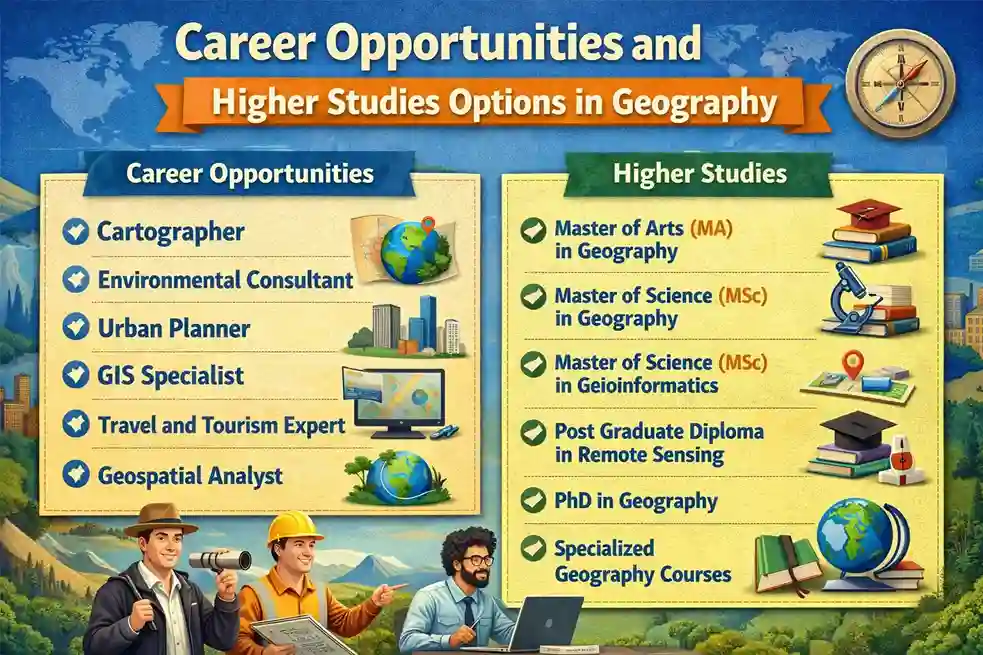
Career with Geography: Education, Scope, and Job Options
Geography is a subject that many students enjoy during school days. It is full of colorful maps, globes, drawings, and interesting facts about India and the world. Students learn about countries, capitals, rivers, mountains, climate, and people. Geography helps us understand how the Earth works and how humans interact with nature. However, as students grow older, many people around them suggest choosing science or commerce because they believe arts subjects have fewer career options. Due to this mindset, geography is often ignored as a serious career choice. In reality, geography offers many good career opportunities if studied properly.
Geography is not only about maps and locations. It is a wide subject that connects natural science, social science, environment, technology, and data analysis. Students who choose geography at the graduation, post-graduation, or research level can build strong and respected careers in India and abroad.
Geography Education and Degree Structure
If a student decides to study geography at a higher level, the usual path starts with a bachelor’s degree such as BA or BSc in Geography. After that, students can pursue a master’s degree in Geography. During the first year of a master’s program, students study subjects like geomorphology, climatology, biogeography, soil science, advanced statistics, cultural geography, global resource issues, and geopolitical topics. These subjects help students understand landforms, climate systems, natural resources, and human society.
In the second year of a master’s degree, students usually study topics such as geoinformatics, regional development models, field survey methods, community outreach programs, geography of disasters, tourism geography, and hazard management. These subjects focus more on practical knowledge, data collection, and real-world applications. The exact syllabus may differ slightly depending on the university or state, but the core concepts remain similar.
Students who want to go further can choose to do a PhD in Geography. For a PhD, most universities require at least 60 percent marks in graduation and around 55 percent marks in post-graduation. These percentage requirements may vary from one university to another. To pursue a PhD in India, students usually need to qualify for the UGC NET examination. During a PhD, students can specialize in areas such as geomorphology, climatology, urban geography, environmental geography, or population studies.
Universities for Geography Studies
In India, many well-known universities offer quality education and research opportunities in geography. Some of these include Banaras Hindu University, University of Mumbai, Aligarh Muslim University, University of Calcutta, Jadavpur University, Jamia Millia Islamia, and Bharati Vidyapeeth. These institutions are known for experienced faculty, good research facilities, and strong academic reputation.
Students who want to study geography abroad also have many options. Universities like the University of Cambridge, Johns Hopkins University, University of Edinburgh, University of Melbourne, King’s College London, and University of Amsterdam offer advanced courses in geography, environmental studies, and related fields. To study in foreign universities, students usually need good scores in exams like IELTS, TOEFL, PTE, or GRE, depending on the country and course.
Career as an Environmental Consultant
One popular career option after studying geography is becoming an environmental consultant. Environmental consultants work with government departments, private companies, and international organizations. Their main job is to study environmental issues related to land, water, and air. They check whether a project may cause pollution and study its impact on nature and human life.
Environmental consultants also suggest solutions to reduce pollution and environmental damage. They conduct field research, collect data, prepare reports, and help organizations follow environmental laws and rules. This career requires strong analytical skills and good knowledge of geography, environment, and sustainability.
Career in Cartography and Mapping
Another important career option in geography is cartography. Cartographers design and develop different types of maps. These maps may be used in textbooks, travel guides, government reports, digital platforms, and navigation systems. Cartographers also work with charts, diagrams, and graphical data.
With the growth of digital technology, cartography now includes digital mapping and Geographic Information Systems (GIS). Cartographers may also restore old maps and convert them into digital formats. Government departments, publishing houses, surveying agencies, and conservation institutes often hire cartographers.
Students can learn cartography through courses such as diploma or degree programs in geoinformatics, GIS, or geographical cartography. Institutes like Annamalai University, Jamia Millia Islamia, Osmania University, IIT Bombay, and Indian Institute of Surveying and Mapping offer relevant courses.
Career as a Town and Urban Planner
Town planning is another strong career option for geography students. Town planners work on the planning and development of cities, towns, villages, and rural areas. Their work includes managing land use, improving infrastructure, planning housing projects, and ensuring balanced development.
Town planners must consider environmental protection, government policies, population growth, and sustainable development. They help create plans that support economic growth while protecting nature and local communities. Students can study urban and regional planning through specialized courses in India and abroad to become town or urban planners.
Geographic Information System Officer
A GIS officer works with computerized systems that collect, store, analyze, and present geographic data. GIS is used in many sectors such as defense, agriculture, oil and gas, transportation, telecommunications, disaster management, and urban development. GIS officers analyze satellite images, maps, and location-based data to support planning and decision-making.
To become a GIS officer, students need knowledge of geography along with data analysis and computer systems. Courses in remote sensing and GIS are offered by institutes like the Indian Institute of Remote Sensing. GIS professionals play an important role in environmental protection and resource management.
Conservation Officer and Environmental Protection Roles
Geography graduates can also work as conservation officers. Their main responsibility is to protect the natural environment and spread awareness about environmental conservation. They guide people on how to live in ways that do not harm nature.
Some conservation officers specialize as soil conservationists or water conservation officers. Soil conservationists work to improve soil quality, prevent erosion, and support sustainable farming practices. Water conservation officers focus on protecting water resources, promoting rainwater harvesting, cleaning lakes and rivers, and managing water usage. These professionals often work with government bodies, NGOs, and research organizations.
Teaching and Academic Careers
Teaching is another respected career option for geography students. To become a school teacher, students usually need a master’s degree in geography and a B.Ed qualification. They may also need to pass teacher eligibility tests at the state or national level.
To become a college lecturer or professor, students must qualify for the UGC NET exam and usually need at least 55 percent marks in their master’s degree. Teaching and research careers offer stability, respect, and opportunities to contribute to education and knowledge.
Career as a Climatologist
With climate change becoming a global concern, the role of climatologists has become very important. Climatologists study long-term weather patterns over months, years, and even centuries. They use data from weather stations, satellites, and computer models to analyze climate trends.
Their work includes preparing reports, predicting weather patterns, studying global warming, and helping governments and organizations plan for natural disasters. A degree in geography with specialization in climatology is essential for this career.
Conclusion
Geography is a powerful and versatile subject with wide career opportunities. It connects nature, humans, technology, and data in a unique way. Students who choose geography can work in environmental protection, urban planning, mapping, education, research, and climate science. With proper education and specialization, geography can lead to a stable, meaningful, and impactful career in India and abroad.