
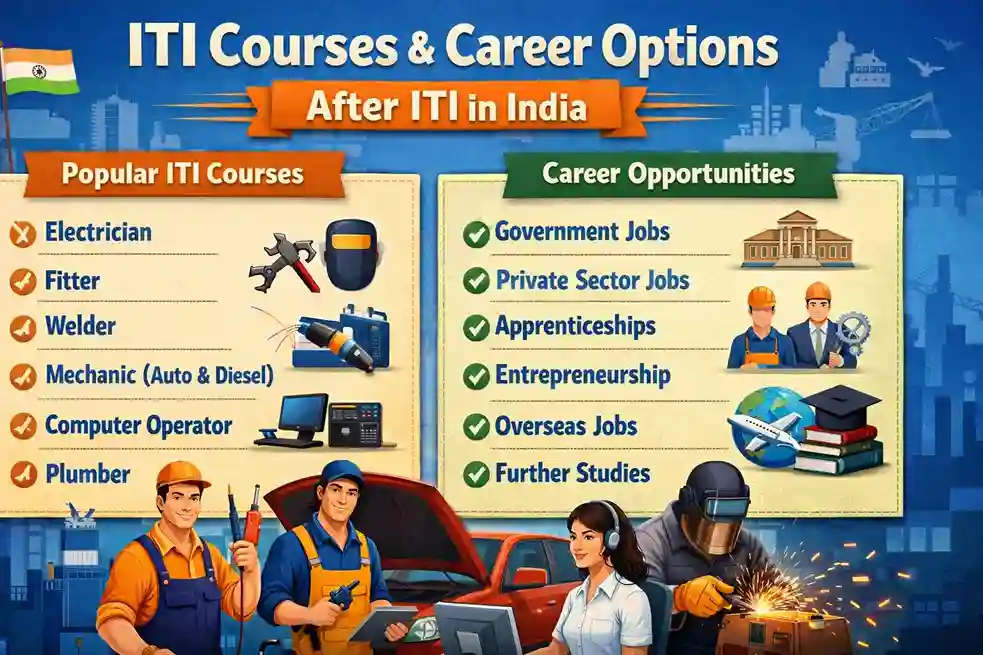
ITI Courses and Career Options After ITI
In today’s world, career success depends more on skills and practical experience than only on degrees. Because of this growing demand for skilled workers, the Indian government launched the Skill India Mission in 2015. However, skill-based training in India did not start recently. Industrial Training Institutes, commonly known as ITIs, have been providing vocational and technical skills to students since 1950. Even though many modern and advanced courses are now available, the popularity and importance of ITI have not reduced. As a developing country, India continues to need skilled technicians, and ITI-trained professionals play a major role in national growth.
ITI is considered the backbone of vocational training in India. Every year, lakhs of students take admission in ITIs across the country. Some students move toward higher education, while many directly join the workforce as skilled professionals. Understanding career options after ITI helps students make informed decisions and build a stable future.
What Is ITI and Why It Matters
Industrial Training Institutes are government and private institutions that provide technical and non-technical vocational training. There are nearly 15,000 ITIs across India, offering around 25 lakh seats. However, only about 10 to 12 lakh students take admission each year. ITIs are managed by various government departments, vocational councils, and training authorities.
There are more than 3,000 government ITIs and over 11,000 private ITIs in India. These institutes focus on hands-on training, which makes students job-ready. ITI courses are designed to meet industry needs, making graduates highly employable.
Eligibility and Admission Process for ITI
Students aged 14 years or above who have passed at least class 8 are eligible to apply for ITI courses. Most ITI students come from class 8, class 10, or class 12 backgrounds. Each state releases its own online admission notification through the State Council for Vocational Training. Admission is usually based on merit, though some states may conduct entrance tests.
The eligibility criteria and course availability may differ slightly from state to state, but ITI remains one of the most accessible skill-based education options in India.
ITI Courses After Class 8
Students who complete class 8 can choose from several ITI trades. These courses focus mainly on basic technical and craftsmanship skills. Popular options include weaving of fancy fabric, wireman engineering, cutting and sewing, pattern making, plumbing, gas and electric welding, book binding, carpentry, embroidery and needlework, and tractor mechanic. These courses are ideal for students who want to start working early and gain practical experience.
ITI Courses After Class 10
After class 10, students have a much wider range of ITI courses to choose from. Some popular trades include fitter, diesel mechanic, pump operator, machinist, tool and die maker, draftsman (civil and mechanical), dress making, footwear manufacturing, information technology, electronics system maintenance, hair and skin care, refrigeration and air conditioning, surveyor, radio and TV mechanic, and many more. These courses prepare students for both technical and service-based industries.
ITI Courses After Class 12
Students who have completed class 12, whether in science, arts, or commerce, can also enroll in ITI courses. Options include electronics mechanic, IT and electronics system maintenance, library and information science, automotive body repair, marine engine fitter, steel fabricator, dental laboratory equipment technician, pump operator-cum-mechanic, and over 100 other specialized trades. These courses help students gain industry-specific skills in a shorter time.
Career Pathways After ITI
After completing an ITI course, students can choose from multiple career paths. One option is self-employment, where they can start their own business as electricians, mechanics, welders, or technicians. Others may work as freelancers or private trade tutors. Students can also join apprenticeship programs to gain real industry experience.
Some ITI graduates choose higher education routes such as Bachelor of Vocation programs or lateral entry into diploma courses. With additional qualifications, they can become technicians, supervisors, or instructors under schemes like the Craft Instructor Training Scheme. Each role requires specific qualifications, training, and sometimes entrance exams.
Government Job Opportunities After ITI
Government jobs are a major attraction for ITI graduates. Indian Railways is one of the largest employers and regularly recruits ITI-qualified candidates. Positions include technician, fitter, electrician, welder, carpenter, painter, trackman, and signal maintainer. The selection process usually includes a written test, skill test, medical examination, and document verification. Monthly salaries generally range from ₹18,000 to ₹25,000 or more.
Defense Sector Jobs After ITI
ITI graduates also have strong opportunities in the defense sector. Organizations such as the Indian Army, Navy, Air Force, BSF, CRPF, ITBP, and other paramilitary forces recruit ITI candidates for roles like tradesman, assistant, electrician, mechanic, fitter, welder, carpenter, and painter. Selection involves physical tests, written exams, and medical checks, depending on the force.
PSU and Public Sector Jobs After ITI
Public sector undertakings also offer excellent career options. BSNL recruits ITI graduates as instrument mechanics and telecom technicians. Candidates with at least 50 percent marks in ITI and SSC, along with NCVT or SCVT certification, get preference.
ONGC also hires trained and experienced ITI professionals such as fitters, welders, electricians, electronic mechanics, turners, and machinists. Recruitment usually involves a written exam, skill test, and interview. Other organizations like NTPC, ISRO, DRDO, BARC, and SSC regularly announce vacancies for ITI-certified technicians.
Private Sector Jobs After ITI
The private sector offers a large number of job opportunities for ITI graduates. Companies in automobile, manufacturing, construction, electronics, and service industries actively hire skilled ITI professionals. Large companies like Maruti, Tata, and many infrastructure firms require electricians, maintenance technicians, fitters, welders, and service engineers.
Job portals show thousands of openings for roles such as ITI electrician, ITI fitter, maintenance technician, electronics technician, junior engineer, service engineer, and operations technician. Salary depends on skills, experience, and location, but growth opportunities are strong.
Higher Education After ITI
ITI graduates can also choose higher education. They get lateral entry into polytechnic diploma courses, where around 10 percent of seats are reserved for ITI students. This allows them to complete a three-year diploma in a shorter duration.
Students can also appear for the All India Trade Test conducted by NCVT. This exam is held twice a year across multiple trades such as electrician, fitter, welder, turner, machinist, diesel mechanic, refrigeration and air conditioning mechanic, computer operator, and draftsman. Clearing this test improves job prospects and skill recognition.
Highly motivated students can even prepare for engineering entrance exams like JEE Main and JEE Advanced. With dedication and hard work, ITI students can secure admission into reputed engineering institutes.
Overseas Job Opportunities After ITI
ITI-trained professionals are in demand not only in India but also abroad. Countries in the Middle East such as UAE, Qatar, Saudi Arabia, and Bahrain regularly hire skilled technicians. European countries like Romania, Hungary, Croatia, and Belgium also offer opportunities. In Southeast Asia, countries like Malaysia, Singapore, Nepal, and Bangladesh recruit ITI professionals.
Common overseas job roles include electrician, fitter, welder, machinist, telecom technician, service technician, and field technician. These jobs often offer better pay and international exposure.
Conclusion
ITI is a powerful career option for students who want skill-based education and early employment. It offers flexibility, practical training, and multiple career paths in government, private, and international sectors. With continuous skill development, experience, and the right choices, ITI graduates can build a successful and stable career. The direction you choose after ITI depends on your interests, effort, and long-term goals, but the opportunities are wide and rewarding.