
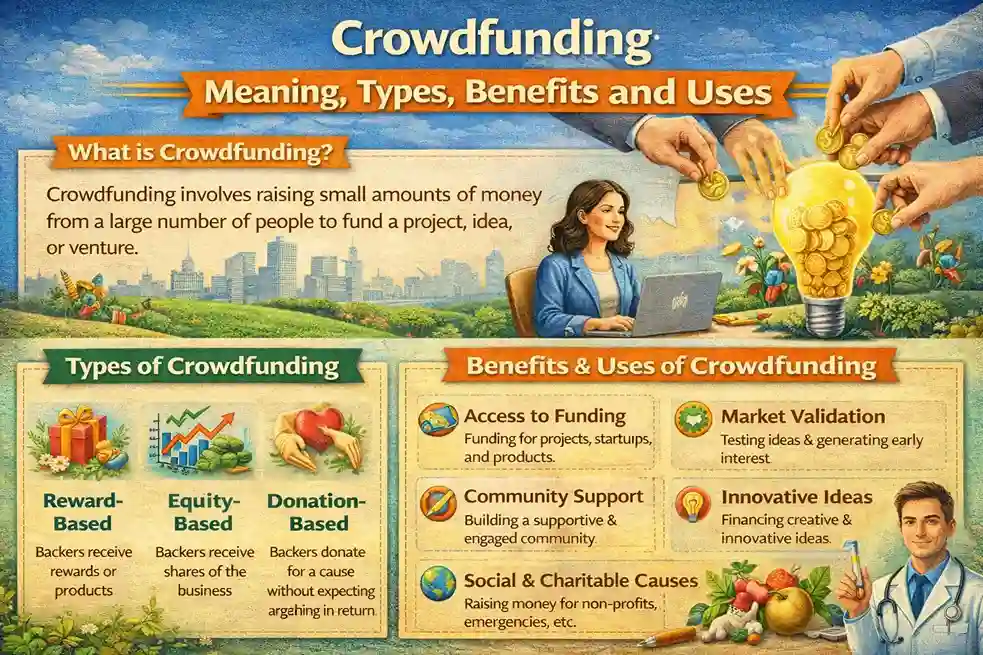
Crowdfunding: Meaning, Types, Benefits, and Uses
Every company needs money and investment to grow. For large companies, raising money is usually easy because many investors trust them and are ready to lend or invest. However, for small companies and startups, getting funds is often very challenging. They usually do not have a strong reputation, long history, or big assets. Because of this, banks and big investors hesitate to support them.
To solve this problem, a powerful and helpful concept has been used for many years, which is called crowdfunding. Today, crowdfunding has become very common and easy to use because of online platforms. Many people think crowdfunding is a new idea, but in reality, it has existed for centuries. Earlier, people used to collect money from small groups, but now, through the internet, money can be raised from a large number of people across the world.
Crowdfunding helps businesses, startups, individuals, and social causes raise money from the public. In this article, you will learn what crowdfunding is, how it works, how it helps businesses, its benefits and drawbacks, and the main types of crowdfunding explained in simple English.
What Is Crowdfunding
Crowdfunding is a method of raising money from a large number of people, where each person contributes a small or large amount. Instead of taking money from one bank or one investor, funds are collected from a crowd of supporters. These supporters can be customers, investors, or people who believe in the idea or cause.
Social media and crowdfunding websites play an important role in this process. They connect entrepreneurs and project creators with a large audience. Through these platforms, anyone can present their idea and ask people to support it financially.
One special feature of crowdfunding is flexibility. People can contribute very small amounts or large sums, depending on their interest and capacity. Crowdfunding can be used for many purposes such as starting a business, launching a new product, helping someone in need, supporting a creative project, or funding a social cause.
How Crowdfunding Helps Businesses and Startups
Crowdfunding does more than just provide money. It gives startups and businesses several additional benefits. One major benefit is market validation. When a business presents its idea to the public and people are willing to invest or contribute, it shows that the idea has demand and future potential.
Crowdfunding also helps in building an audience. Before a product or service is officially launched, people already know about it. This creates awareness and trust. Businesses also receive early feedback from supporters, which helps them improve their product or service before launch.
A successful crowdfunding campaign can also work as a strong marketing and publicity tool. It attracts media attention and makes it easier to reach potential partners and future investors. This increases the chances of getting more funding opportunities later.
Crowdfunding platforms charge a service fee for hosting campaigns. This fee is usually a percentage of the total funds raised. Even with this fee, crowdfunding remains a popular option because of its wide reach and benefits.
Types of Crowdfunding
Crowdfunding is not limited to one model. There are four main types of crowdfunding, and each type serves a different purpose. Choosing the right type depends on the nature of the project, financial needs, and long-term goals.
Reward-Based Crowdfunding
Reward-based crowdfunding is commonly used by startups to launch new products or services. In this model, people who contribute money receive a reward in return. The reward is usually the product itself, a service, or some exclusive benefit.
Popular platforms for reward-based crowdfunding include Kickstarter and Indiegogo. In this model, the company does not give away ownership or shares. This is a major advantage because founders can keep full control of their business.
Reward-based crowdfunding is also a good way to test market interest. If many people support the campaign, it shows strong demand. However, there is a risk involved. If the startup fails to produce or deliver the promised rewards on time, its reputation can be damaged, and supporters may ask for refunds.
Equity-Based Crowdfunding
In equity-based crowdfunding, investors receive company shares in exchange for their investment. This means they become part owners of the company. This model is mostly used by startups with high growth potential because it allows them to raise large amounts of money.
Platforms like SeedInvest and CircleUp support equity-based crowdfunding. The main benefit of this model is that investors are willing to invest larger amounts because they expect long-term returns. It also helps build long-term relationships between the company and investors.
The main drawback is that founders must give up part of their ownership and share decision-making power. This can reduce control over the company. Also, legal and regulatory requirements for equity crowdfunding are more complex compared to other types.
Debt-Based Crowdfunding
Debt-based crowdfunding is also known as peer-to-peer lending. In this model, money is raised as a loan from multiple investors instead of a bank. The business agrees to repay the loan with interest over a fixed time period.
Platforms like LendingClub and Prosper are examples of debt-based crowdfunding. The biggest advantage of this model is that businesses do not need to give up ownership. Once the loan is repaid, there is no further obligation to investors.
Debt-based crowdfunding is usually faster than traditional bank loans. However, the downside is that the business must repay the loan along with interest, which can be a burden if cash flow is weak.
Donation-Based Crowdfunding
Donation-based crowdfunding is mainly used by non-profit organizations and individuals for social and charitable causes. In this model, donors give money without expecting any financial return.
Platforms like GoFundMe are popular for donation-based crowdfunding. People donate because they believe in the cause and want to help. This type of crowdfunding is widely used for medical help, disaster relief, education support, and community projects.
The biggest advantage is that there is no need to repay money or give equity. It also helps build a community of supporters who care about social issues. However, the reach of donation-based campaigns can sometimes be limited, and success depends heavily on emotional appeal and awareness.
Important Points to Consider Before Choosing Crowdfunding
Before using any type of crowdfunding, it is important to choose the right model based on the nature of the project or business. For launching a new product or service, reward-based crowdfunding is usually the best option. If a company wants to raise a large amount and is willing to share ownership, equity-based crowdfunding is suitable. If the business is confident about loan repayment, debt-based crowdfunding can be a good choice. For strong social missions, donation-based crowdfunding works best.
Financial needs also play an important role. Large funding requirements are better met through equity or debt-based crowdfunding, while smaller needs can be fulfilled through reward or donation-based models.
Market validation is another key factor. If testing product demand is important, reward-based crowdfunding helps gather both funds and customer feedback.
Ownership and control must be carefully considered. If founders want to keep full ownership, they should avoid equity-based crowdfunding. The ability to fulfill promises is also important. Rewards should only be offered if they can be produced and delivered on time. Loans should only be taken if repayment is realistic.
Legal and regulatory requirements should not be ignored. Equity-based and debt-based crowdfunding involve complex laws and compliance rules, so businesses must ensure they can meet these requirements before choosing these options.
Conclusion
Crowdfunding is a powerful and flexible way to raise funds for businesses, startups, individuals, and social causes. It allows people to collect money from a large audience instead of depending on traditional funding sources. Along with funding, it provides market validation, audience building, feedback, and publicity.
Different types of crowdfunding serve different purposes, and choosing the right one is essential for success. By understanding the types, benefits, risks, and important factors, anyone can decide whether crowdfunding is the right option for their project or business. When used correctly, crowdfunding can turn ideas into reality and help meaningful projects grow successfully.