
The Placebo Effect
When we do not feel well, we usually visit a doctor, take medicines, and follow treatment to recover. Most of the time, this works and our health improves. Medicines and medical treatments are considered real and effective ways to cure illness. But what if a person starts feeling better even after taking a fake pill or receiving a harmless injection with no real medicine in it? What if improvement happens without any active medical treatment? This surprising situation is known as the placebo effect.
The placebo effect clearly shows the deep connection between the human mind and body. It proves that our beliefs, expectations, and thoughts can directly influence how our body feels and responds. The human mind is very powerful, and when it believes that healing is happening, the body may actually start to feel better, even without real medicine.
What Is the Placebo Effect
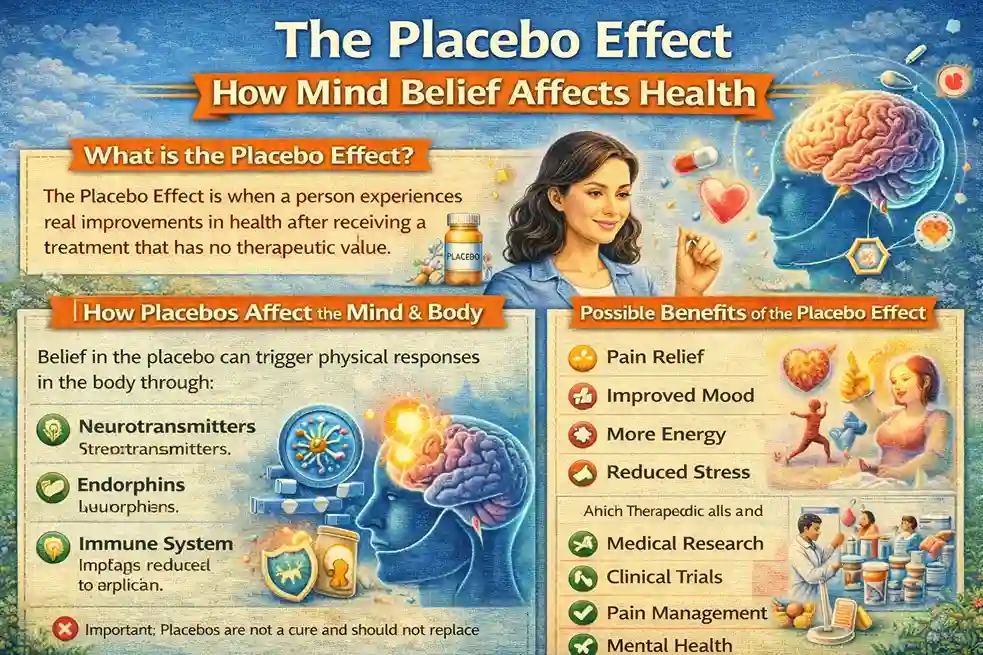
The placebo effect happens when a person feels real improvement in physical or mental health after receiving a treatment that has no active medical ingredient. This treatment may look real, but it does not contain any actual medicine. It can be a sugar pill, a saline water injection, or even a fake medical procedure.
In simple words, the placebo effect is when the mind believes that treatment is real, and because of this belief, the body starts responding positively. The improvement is not caused by medicine but by the brain’s response to expectation and belief.
Why Placebo Is Used in Medical Studies
Placebos are mainly used in clinical trials to test how effective a new treatment or medicine is. In these trials, participants are divided into two groups. One group receives the real medicine, while the other group receives a placebo. After some time, the results of both groups are compared.
This comparison helps researchers understand whether the new medicine works better than no treatment at all. If a real medicine shows much better results than the placebo, it is considered effective. Placebo treatments are considered safe in trials and are used only in health conditions where there is no serious risk involved. That is why placebo use is very rare in life-threatening diseases like cancer.
Single Blind and Double Blind Trials
Clinical trials using placebos can be single blind or double blind. In single blind trials, participants do not know whether they are receiving real medicine or a placebo. In double blind trials, neither the participants nor the researchers know who is receiving the real treatment and who is receiving the placebo.
In double blind trials, only a separate monitoring team knows the details. This method helps reduce bias and ensures more accurate results.
Positive Results Seen with Placebo
Many studies have shown that placebo treatments can produce positive results. People taking placebos have reported improvement in conditions like depression, anxiety, stress, headaches, and back pain. In some trials, even when participants knew they were taking a placebo, they still felt better. This is known as open-label placebo.
One study related to migraine pain showed that people who took a real migraine medicine felt relief, but people who took a placebo pill also experienced about 50 percent improvement. This happened even when the placebo pill was clearly labeled as a placebo.
How the Placebo Effect Works
The placebo effect works mainly because of the brain. The human brain responds not only to real situations but also to imagined ones. When a person takes a pill, drinks medicine, or gets an injection, the brain recognizes this as a treatment process.
This sends a signal to the body that healing has started. As a result, the brain releases natural chemicals like endorphins, which reduce pain and create a feeling of comfort and relaxation. Because of this response, symptoms may reduce and the person starts feeling better.
The brain does not always differentiate between real medicine and a placebo if the belief is strong. That is why even fake treatment can lead to real physical changes.
What the Placebo Effect Cannot Do
Although the placebo effect is powerful, it has its limits. It cannot shrink tumors, cure serious infections, or replace real medical treatment for major diseases. However, it can help reduce pain, manage stress, improve sleep, and lower discomfort caused by side effects of treatments.
The placebo effect is often helpful in pain management, stress-related conditions, insomnia, irritable bowel syndrome, menopause symptoms, and side effects like nausea and fatigue during cancer treatment. It also provides relief in anxiety and depression and motivates people to take better care of themselves.
Factors That Affect the Placebo Effect
The strength of the placebo effect depends on many factors. One of the most important factors is belief and expectation. If a person truly believes that a treatment will help, the chances of positive results increase. Trust in treatment plays a major role.
Attention and care during clinical trials also affect results. When participants receive regular checkups and care, their stress levels reduce. This helps the body release pain-relieving chemicals.
Previous experiences also matter. If a person has seen positive results from medicines in the past, their brain is more likely to respond positively to a placebo. The relationship between doctor and patient also influences outcomes. When communication is clear and supportive, patients feel more confident and relaxed.
Even the appearance of a placebo matters. Pills that look like real medicine, larger pills, or multiple doses are often believed to be stronger. Research also shows that placebo injections tend to have a stronger effect than placebo pills.
The Nocebo Effect
Just like placebo can cause positive results, it can also cause negative results. This is called the nocebo effect. It happens when a person expects negative side effects from a treatment, even if the treatment is harmless.
For example, if participants are told that a treatment may cause headache, nausea, or dizziness, they may start experiencing these symptoms even when they receive a placebo. This shows that negative expectations can also affect the body.
The nocebo effect is considered a negative side effect of placebo use and shows how powerful negative thoughts can be.
Ethical Concerns About Placebo Use
The use of placebos is sometimes considered controversial and unethical because patients may not always know they are receiving a fake treatment. There is also a risk that a patient may not receive real medical help when needed.
Despite these concerns, placebo use plays an important role in medical research. It helps scientists develop safe and effective treatments. Strict rules and ethical guidelines are followed to protect participants from harm.
Conclusion
The placebo effect clearly shows how strongly the mind and body are connected. Our thoughts, beliefs, and expectations can influence how our body feels and responds. While the placebo effect cannot replace real medical treatment, it can help reduce pain, manage stress, and improve overall well-being.
Understanding the placebo effect teaches us the importance of positive thinking, trust, and mental strength. When the mind believes in healing, the body often follows. This powerful connection can be used carefully to support better health, happiness, and quality of life.